

Spiff3D now operates as Spiff Commerce, a personalisation platform for made-to-order products with a strong focus on fulfilment automation and quoting. Zakeke covers the same ground, 2D and 3D customization with production files and automation, and adds AR, Virtual Try-On, Visual CPQ and 3D asset management in one platform that you can start with a free trial and grow into Enterprise. If orchestrating made-to-order tasks after the sale is your main problem, Spiff Commerce deserves a close look.
Choose Spiff Commerce when task orchestration across a made-to-order operation, customer interaction automation or Design To Quote for branded B2B products is the heart of the project.
Choose Zakeke when you want customization, 3D configuration, AR, Virtual Try-On and production-ready files in one platform, on the ecommerce stack you already use, with a path from self-service to Enterprise.
| Comparison area | Spiff Commerce | Zakeke |
|---|---|---|
| Core positioning | Personalisation platform for made-to-order commerce and fulfilment automation | Visual commerce across personalization, 3D, AR, VTO, CPQ and 3D assets |
| 3D configuration | Real-time 3D product customization | Yes, full 3D product configuration |
| Visual CPQ | Design To Quote module | Yes |
| Design to Print / personalization | Yes: 2D and 3D Product Customizer | Yes, with a dedicated Visual Product Customizer |
| AR | Not mentioned on the vendor site | Yes |
| Virtual Try-On | Not mentioned on the vendor site | Yes |
| Production-ready files | Yes: PDF, JPEG, PNG, SVG, DXF | Yes: PDF/PNG/SVG/DXF |
| API | Yes | Yes |
| Enterprise systems | Shopify, BigCommerce, WooCommerce, Magento, plus HubSpot, Salesforce and CIN7 connections | Native commerce plus API/PIM/enterprise |
| Self-management | Self Service Hub | Self-provisioning plus Enterprise |
| Pricing | Shopify app from USD 139 a month plus transaction fees and add-ons; no plans on the website. | Published Starter, Grow and Scale plans plus Enterprise |
Both platforms let shoppers personalise a product and both hand production a usable file. The difference is where each one puts its weight. Spiff Commerce has built its suite around what happens after a made-to-order sale: task orchestration, order management, customer interaction automation and moderation.
Zakeke puts the same production discipline behind a much wider buying experience. One platform covers 2D personalization, 3D configuration, AR, Virtual Try-On, quoting and 3D assets, on the ecommerce platform you already run. If the catalogue mixes printed goods with products shoppers need to rotate, place in a room or try on, that breadth decides the comparison.
In practice the choice depends on where the effort sits in your business. If most of the work happens once the order exists, routing jobs, approvals and customer messages, Spiff Commerce’s operations modules speak to that. If the work starts earlier, in helping the shopper understand, configure and trust a product before buying, Zakeke’s broader front end is where the return comes from, and it still hands production a finished file.
Spiff Commerce suits a made-to-order business whose personalised range already sells and whose pain is the operational load behind it: many hands, many stages, many customer touchpoints per order. Its task orchestration routes personalised jobs across people and production stages, and Design To Quote serves customised B2B proposals such as corporate gifting, with a Moderation Console and a Customer Portal around them. The vendor claims a 1.5x average increase in conversions.
Zakeke supports that business and the ones around it inside the same technology stack: printing businesses that need web-to-print and production-ready output, manufacturers selling configurable products, furniture brands combining 3D with AR, fashion and luxury brands using Virtual Try-On, and multi-category merchants that need different experiences for different products. More than 25,000 brands use Zakeke, from a first store to Enterprise manufacturers.


Customization answers one question: what will my version of this product look like? Visual commerce answers a longer list. What does the finished object look like from every angle, in my room or on me, what does this combination cost, and what file does the machine need to make it.
Spiff Commerce is focused on the first question and on the operations after it. Zakeke is built around the whole list, which is why one account covers 2D personalization, 3D configuration, AR, Virtual Try-On, quoting and production-ready files instead of adding tools one by one.
For a made-to-order business that difference shows in the catalogue over time. A personalised gift range may need only 2D; a furniture or sporting goods line added next year will need 3D and AR. Keeping both on one platform means one set of rules, one production output and one team trained on one tool.
Both products export vector and raster files for production. Spiff Commerce lists PDF, JPEG, PNG, SVG and DXF. Zakeke exports PDF, PNG, SVG and DXF through its Visual Product Customizer, with print areas, layers and rules set by the merchant so the customer can only design what you can produce.
On file output the two are close. The difference is what surrounds it: Zakeke pairs the same output with a dedicated web-to-print customizer, 3D and AR, across a wider set of commerce platforms.
Both approaches also constrain what the customer can design, which is where most production errors are prevented. In Zakeke the print areas, fonts, colours, clipart and image uploads are rules on the product, so a file that reaches production has already passed the checks a prepress operator would otherwise do by hand.
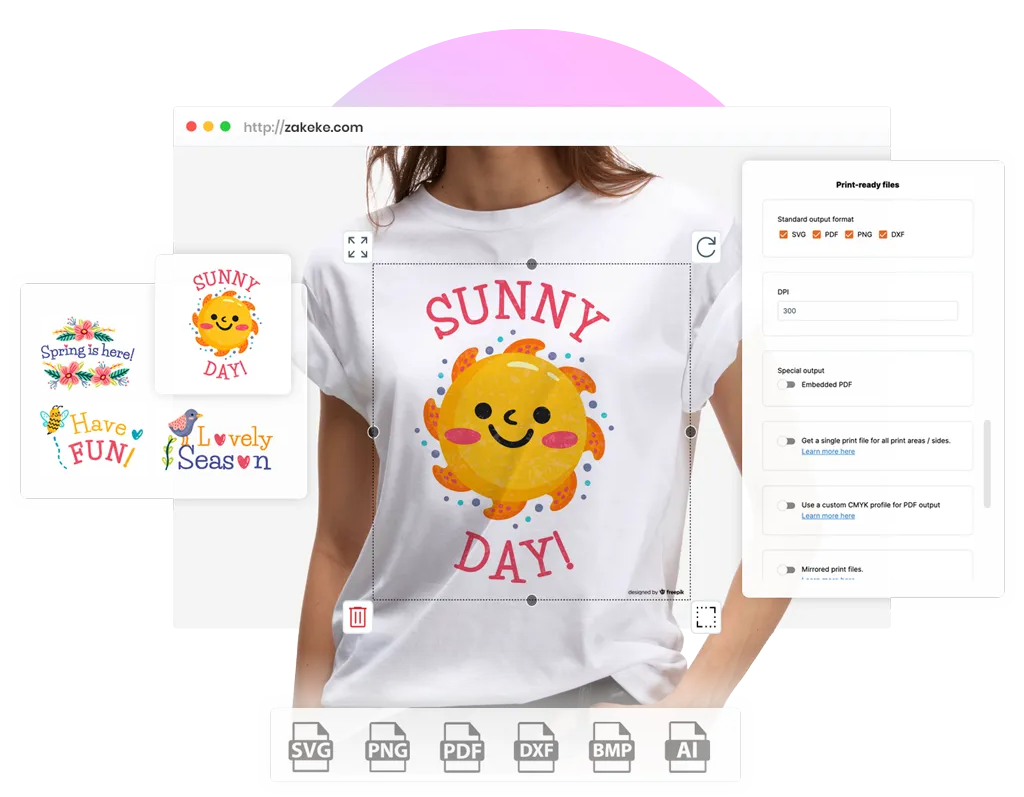

Spiff Commerce promotes real-time 2D and 3D product customization, so 3D is not a gap. Zakeke splits the job: a Visual Product Customizer for products where the shopper adds artwork, text or photos, and a dedicated 3D Product Configurator where geometry, components and materials change and rules decide what can be built.
On quoting, Spiff’s Design To Quote is built for customised B2B proposals. Zakeke’s Visual CPQ works inside the configurator: option rules and dependencies drive a live price, and Get a Quote can replace or sit next to Add to Cart. Once the quote is accepted, the configuration moves toward production with its files.
For B2B sellers the practical test is simple: configure a real product, request a quote, approve it, and look at what arrives in production. The fewer manual steps between the approved quote and the production file, the more the tool is doing for you.
Spiff Commerce offers a Self Service Hub, and its Shopify app is installed like any other app; its website does not publish plans, so larger projects start with a conversation.
Zakeke is self-provisioning: connect the store, configure a product and go live during a 14-day free trial, with no implementation project in between. When the requirement grows, Enterprise adds tailored architecture and integrations on the same platform.
For most standard products the setup is configuration rather than code: print areas, options, rules and prices are defined in the Zakeke back office and published to the store. Developers are needed only when the project uses the API, a custom storefront or an enterprise integration, which is where the Enterprise team and a scoped project come in.


Spiff Commerce connects to Shopify, BigCommerce, WooCommerce and Magento, lists Klaviyo, HubSpot, Salesforce and CIN7 among its connections, and exposes an API for two-way data exchange.
Zakeke runs natively on Shopify, WooCommerce, BigCommerce, Wix, PrestaShop, Magento, Salesforce Commerce Cloud, Shopware, Etsy and more, and adds API, webhooks, Zapier and PIM sync. If you run a second store elsewhere, or expect a replatform, that breadth is the difference between one customizer and two.
Integration depth matters as much as the list. With a native integration the customised product, its price and its production file travel with the order inside the store’s own order flow, so fulfilment teams keep working where they already work instead of checking a second dashboard.
The design file is only the start. Somebody has to get it to production with the order attached, at the right size, in the right colour space, in the right place in the queue. Spiff Commerce answers this with its own orchestration modules, which is a strength when those modules match your process closely.
Zakeke is built to be connected to your production workflow. Every order carries production-ready files in PDF, PNG, SVG and DXF, generated to the rules you set for DTG, sublimation, screen printing and engraving. The order data then moves where your operation already runs: POD and dropshipping partners such as Printful and CustomCat, Zapier and Order Desk for routing, API and webhooks for your own systems, and PIM and enterprise integrations when the project needs them.


The strongest reason to implement either platform is not the visual effect itself; it is what happens after the customer finishes. Zakeke constrains designs to what can actually be produced, applies pricing rules and sends production-ready output automatically, so growth in volume does not become growth in headcount.
A proof of concept should measure how many manual checks, artwork adjustments, emails and production steps remain per order on each platform.
That is also where the two platforms meet on common ground: both are built to take manual work out of personalised orders. The difference is that Zakeke applies the same automation to every product type it sells, from a printed mug to a configured 3D product, so the gain does not stop at one part of the catalogue.
With Zakeke, businesses control text, fonts, clipart, images, variants, colours and personalization areas, and build pricing logic around quantity, setup costs, number of colours and other product properties.
The platform supports production-oriented personalization across techniques such as DTG, sublimation, screen printing and engraving. Customization has to respect what the business can actually manufacture, and the rules are where that happens.
Rules are also where production knowledge is kept. Once a print method, its colour limits and its setup cost are encoded on a product, every new order follows them without someone explaining them again, which is what lets a team add products and channels without adding the same number of checks.

Spiff Commerce is a serious choice for a made-to-order operation that already knows its process and wants to orchestrate it. The question is what happens when the business widens: a product line that needs 3D, a furniture range that needs AR, eyewear that needs Virtual Try-On, a second sales channel. Zakeke is built so that each of those is a module switched on in the same account, from a 14-day free trial on the Starter, Grow and Scale plans to an account-based Enterprise deployment, rather than another vendor to integrate.
14-day free trial, standard plans, native ecommerce integrations and a practical route to validate real products quickly.
Product Customizer, 3D Configurator, AR, VTO, Visual CPQ, production automation and 3D asset management as requirements expand.
Tailored architecture and commercial model for complex catalogues, integrations, governance, workflows and larger organizations.
Prices come from each vendor’s public pages and either vendor can change them. Spiff Commerce: the website does not publish plans; the Spiff Connect app on Shopify starts at USD 139 a month plus transaction fees and add-ons, with the entry plan limited to 2 products and 3 users. Zakeke: the self-provisioning Starter, Grow and Scale plans are published on the Zakeke pricing page, with a 14-day free trial, and Enterprise is quoted per account.
Calculate subscription and usage costs together with add-ons, products you will publish, integrations, support and the internal labour that remains in design, quotation and production.
A modular suite and a platform with published plans also buy differently. With add-ons, the cost grows with the modules switched on. With Zakeke, each plan sets the number of products, the fee and the features, and the step to Enterprise is a conversation about volume, integrations and terms rather than a new product list.
On the Shopify App Store the Spiff Connect app holds 5.0 out of 5 from 10 reviews. The sample is small, so use it as supporting evidence rather than a definitive verdict, and test the platform on your own products.
On G2 a product called Spiff is a different, unrelated sales-commission tool, so buyers researching reviews should be careful not to mix the two. Reference calls with made-to-order businesses of a similar size remain the most reliable check. For comparison, Zakeke holds 4.7 out of 5 from 99 reviews on the Shopify App Store and 4.6 from 87 on G2.
When coordinating made-to-order tasks across teams is the main problem and the storefront experience is already solved; when Design To Quote for corporate gifting is the core use case; and when AR, Virtual Try-On and 3D asset management are not on the roadmap.
It is also a reasonable fit when the storefront is simple, the catalogue is stable and the team prefers to invest in back-office workflow rather than in new ways of presenting products online.
When you want one platform for personalization, 3D configuration, AR and Virtual Try-On; when you sell on more than one ecommerce platform; when you want to test on your own products today with a free trial; and when you need a vendor that moves with you from a first product to an Enterprise deployment connected to your production and business systems.
It also fits when one team has to serve very different product lines, printed, configured and wearable, without running a separate tool for each.
If you sell one personalised product with a text field, a basic product-options app will do. If you only need a 3D viewer with no customization, a lightweight viewer is cheaper. If configuration is engineering-grade CAD, specialist engineering software is the right category. In that case, start from the wider picture: Zakeke alternatives compared.
And if the real bottleneck is order volume rather than personalisation, a production management system may deliver more than any front-end tool.
Fill in the form to see how brands like yours boost conversions with tailored, hyper-realistic 3D product experiences powered by Zakeke.
Yes. Spiff3D now operates as Spiff Commerce, a personalisation platform for made-to-order commerce with 2D and 3D customization, fulfilment automation and Design To Quote.
Neither is mentioned on the Spiff Commerce website. Zakeke offers AR and Virtual Try-On alongside its customizer and 3D configurator.
The Spiff Connect app on Shopify starts at USD 139 a month plus transaction fees and add-ons. The website does not publish plans.
Both generate production files, including SVG and DXF. Spiff Commerce focuses on orchestrating tasks after the order; Zakeke focuses on sending a correct file and order data to production through native integrations, Zapier, Order Desk, API and webhooks.
Besides Zakeke, the usual shortlist includes Customily for print on demand, Kickflip for simple Shopify customization and Expivi for enterprise configuration with quoting. Which one fits depends on whether you need a customizer, a configurator or both.
Both, on the same platform. A small team can start with a 14-day free trial on the Starter, Grow and Scale plans. Larger brands and manufacturers use account-based Enterprise deployments with deeper integrations, governance and ISO 27001 and SOC 2 Type 2 security.
Yes. The catalogue stays in your ecommerce platform and the customizer is what changes. The work is rebuilding the customisable products, their rules and the production outputs in Zakeke, not migrating the store.
This comparison is published by Zakeke and is therefore not independent third-party editorial content. It was prepared using current public product documentation, pricing pages and app-store listings, plus third-party review signals where relevant. The competing product is credited where it is the stronger fit, and prices and ratings come from public sources that can change.