


Shoppers want products that fit them: their size, their style, their use case. E-commerce product configuration is how online stores deliver that at scale, without turning every order into a manual quote or every variant into a separate SKU.
This guide explains what product configuration is, how an ecommerce product configurator works, which industries use it best, its benefits and limits, and how to choose and implement the right product configuration software in 2026.
Product configuration is the method that lets a company tailor a product to each customer’s preferences by combining predefined options: color, material, size, components and finishes. In e-commerce, product configuration happens online, where shoppers select options on the product page and see the finished product before they buy.
Think of letting customers select a bag’s color, choose a shoe’s material, or decide the leather type for a luxury sofa. Each is a configured product: the brand defines what can change, the customer decides how.
Online product configuration relies on software integrated with the store. A product configurator tool presents the options, blocks combinations that cannot be produced, recalculates the price and renders the final product in real time, so the preview always matches the selection.
Online product configurations are built on modularity. Instead of a separate SKU for every variant, the product is split into building blocks, such as frame, fabric and finish, each handling one aspect of the product. This keeps the catalog manageable, makes rules easy to maintain and lets production read each order as a clear list of components.
Product customization usually means adding personal content, such as text, a logo or a photo, to a base product. Product configuration means assembling the product itself from options and components. Many stores need both, so the guide to product customization for ecommerce is a useful companion.
| Aspect | Product configuration | Product customization |
|---|---|---|
| What changes | Components, materials, sizes | Text, logos, images |
| Typical products | Furniture, footwear, eyewear | Apparel, mugs, packaging |
| Core logic | Compatibility rules, dynamic pricing | Print areas, design templates |
| Production output | List of options and components | Print-ready artwork file |
An ecommerce product configurator is software embedded in an online store’s product page that lets shoppers choose options, validates each combination against production rules, updates price and preview in real time, and sends a complete order specification to the cart and to production. An ecommerce configurator turns a complex catalog into one guided buying flow.
On the storefront, shoppers see one product page instead of dozens of variants. Behind it, an ecommerce product configurator solution connects four layers: options, rules, visualization and order data.

Not every store needs the same kind of product configurator. Ecommerce teams usually choose among four approaches, depending on product complexity and whether customers buy at checkout or through a quote.
| Type | How it works | Best for | Limits |
|---|---|---|---|
| Option selector | Dropdowns change variant and price | Few simple options | No real preview |
| 2D visual configurator | Layered images update per choice | Apparel, accessories | Limited angles |
| 3D product configurator | Real-time 3D model, often with AR | Furniture, footwear, eyewear | Needs 3D models |
| Visual CPQ | Configuration plus pricing rules and quotes | B2B, bulk, made-to-order | Longer pricing setup |
For products sold through quotes, a Visual CPQ for configure, price, quote workflows adds pricing rules and quote requests.

The rise of customization in e-commerce is a key trend because shoppers are moving away from mass-produced, one-size-fits-all products and expect brands to adapt to them. Customization lets customers express individuality, and it gives online stores a way to stand out where identical products compete only on price.
The data supports the shift. According to McKinsey, 71% of consumers expect companies to deliver personalized interactions, and 76% get frustrated when this does not happen. A 2024 Deloitte Digital study found that 80% of consumers surveyed prefer brands that offer personalized experiences.
The same study shows a gap: 92% of retailers surveyed believe they personalize effectively, but only 48% of consumers agree. A product configurator helps close that gap, because the personalization is visible in the product itself. That is why companies keep investing in on-demand customization services.
When shoppers see the added value of a product built for them, price becomes a secondary consideration, and many accept waiting longer for a made-to-order item.
The best product configuration examples come from industries where products combine several visible choices: made-to-order fashion, eyewear and jewelry, furniture and home decor, and sportswear. In each example of product configuration below, a configurator replaces a large variant catalog with one guided product page.
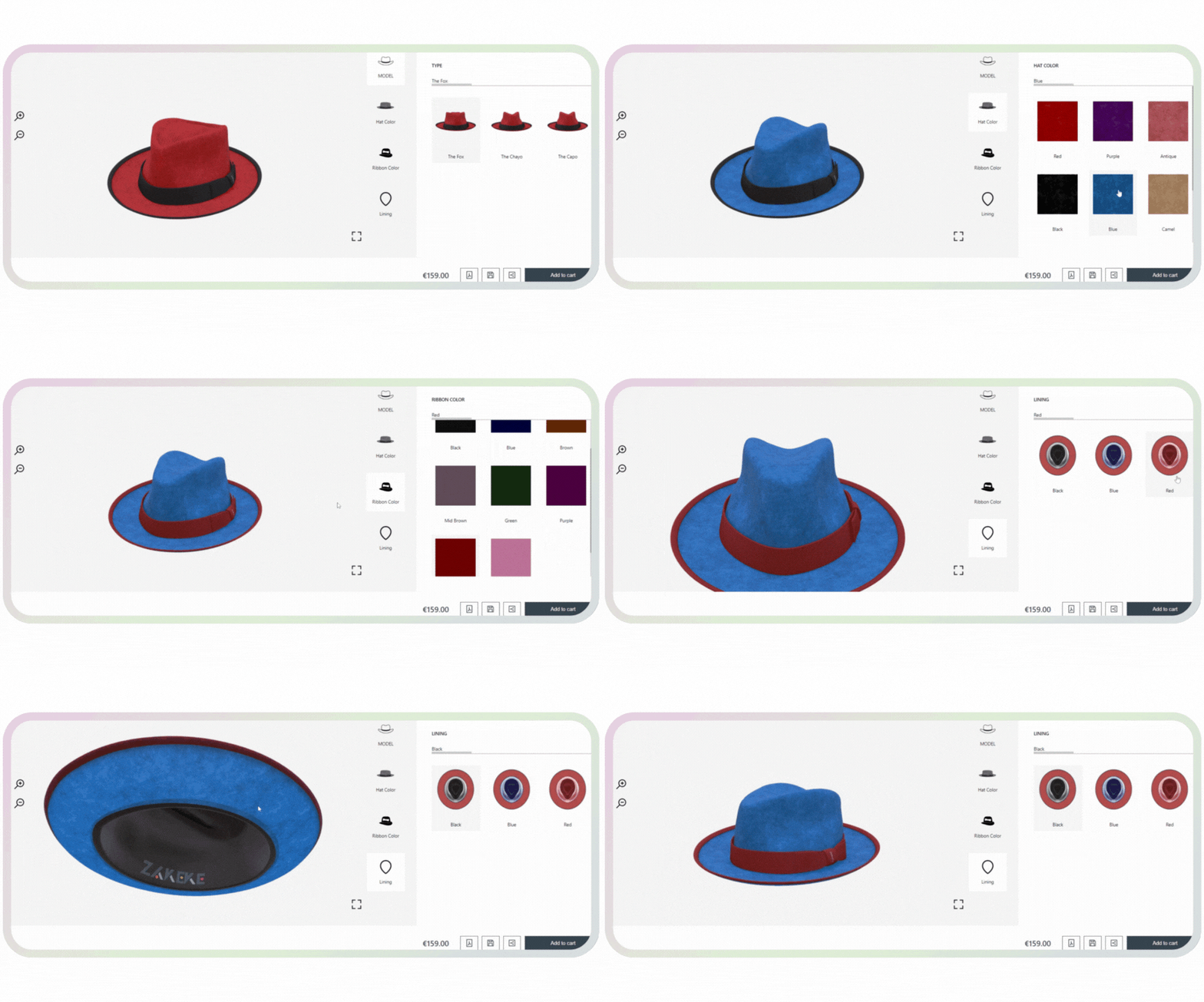
Fashion is a natural market for made-to-order products. Bags, hats and sneakers can be configured by material, color, stitching and hardware. A clothing configurator lets customers build the item while the brand produces only what has been sold.
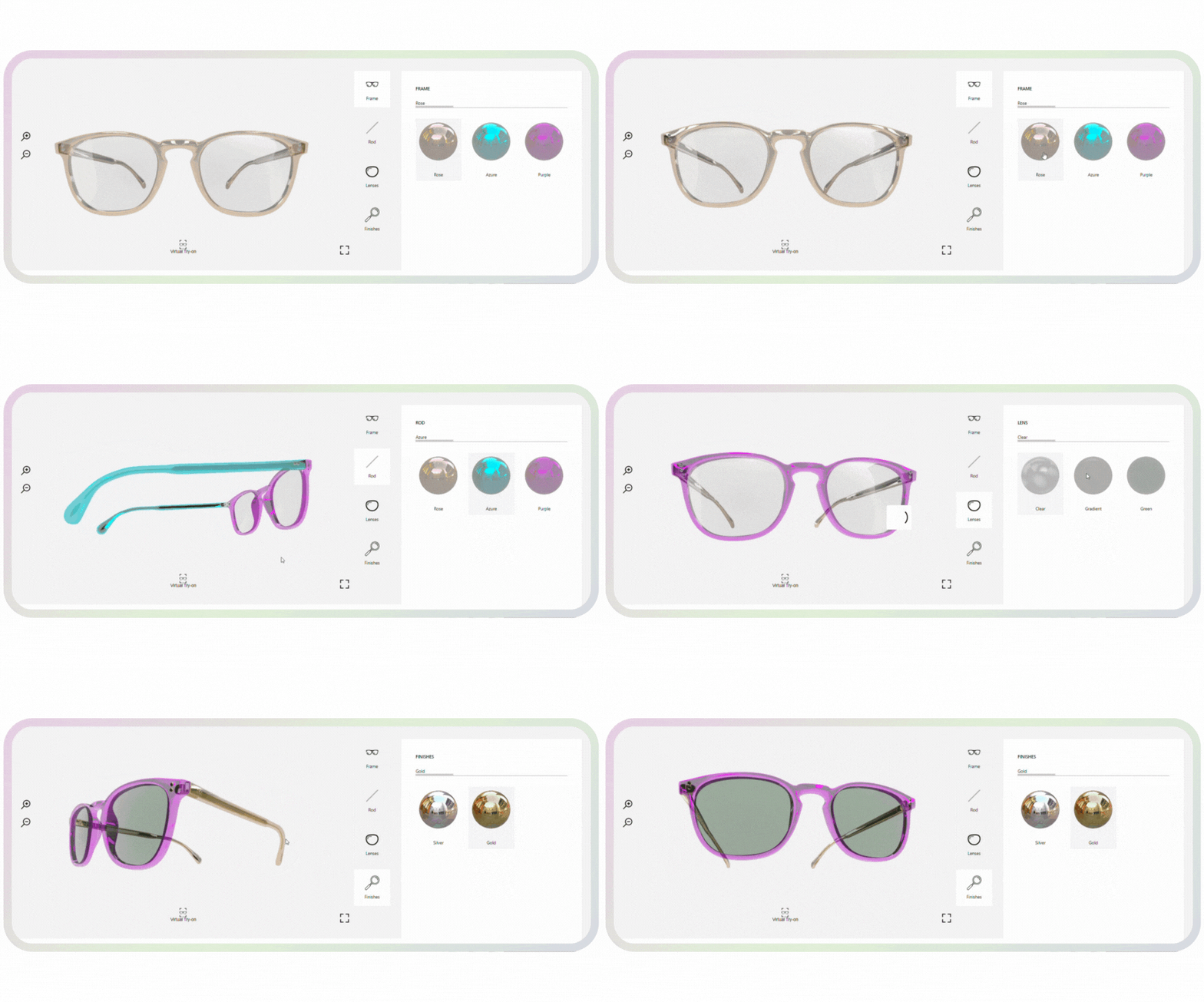
Another perfect market for e-commerce product configuration? Jewelry and accessories. Imagine your customers designing their glasses, necklaces, or rings… Tailor-made luxury items, what could be better than a jewelry configurator?
Furniture configuration is one of the most established use cases. Shoppers choose fabrics, finishes, dimensions and modules for sofas, tables or gaming chairs, then check the result in their room, as shown in the guide on how to use augmented reality for ecommerce.

Athletes and teams want gear that is unique and functional: helmets, ski masks, jerseys and full kits. A uniform configurator lets teams choose colors, names and numbers in one flow and sends a complete specification to production.

Kay Jewelers lets customers design their own engagement ring by stone, shape and metal. Cadillac offers an online configurator to build and price vehicles by model, trim, powertrain, colors and packages. Sneaker fans design their own pairs through Converse By You and Nike By You.
The 5 key benefits of product configuration in e-commerce are higher sales, fewer returns, better customer experience, a premium brand image and leaner inventory. A product configurator delivers them because customers commit to a product they designed, see exactly what they will receive, and trigger production only after purchase.
When customers adjust a product to get exactly what they want, they invest time in it, and that personal connection moves them toward checkout. Deloitte Digital’s 2024 research found that consumers report spending 50% more with brands that offer personalized experiences. Premium options shown at the moment of choice also support average order value.
When customers adjust a product to get exactly what they want, they invest time in it, and that personal connection moves them toward checkout. Deloitte Digital’s 2024 research found that consumers report spending 50% more with brands that offer personalized experiences. Premium options shown at the moment of choice also support average order value.
Designing your own product turns shopping from a routine task into an enjoyable experience. The formula is simple: better customer experience means happier customers, and happier customers mean repeat business.
Product configuration tells customers the store sells a bespoke experience, not just products. It sets the brand apart from competitors selling the same catalog and attracts customers looking for something beyond the ordinary.
By producing only what customers have already configured and bought, businesses reduce unsold stock and markdowns. Every configured unit produced already has a buyer.
E-commerce product configuration is a strategic choice, not a feature: it connects what customers want with what production makes.
The eco-friendly impact of 3D product configuration comes from replacing physical samples, photo shoots and speculative stock with digital models. Customers see and customize products on screen, so brands build fewer prototypes, shoot fewer variants and manufacture closer to real demand, which reduces waste and overproduction.
The same 3D models serve product pages, marketplaces, social content and AR, as explained in the guide to 3D product visualization for ecommerce. But the benefit is real only if operations follow: a 3D configurator on top of a warehouse of pre-made variants changes the shopping experience, not the footprint. The gain comes from pairing configuration with on-demand production.

To implement a website product configurator, retailers map configurable options and rules, prepare visual assets, choose between custom development and a third-party configurator, integrate it with the e-commerce platform and order management, then test and measure. For most e-stores, a third-party service is the fastest and least risky path.
Options range from in-house development, with DIY software or spreadsheets, to a third-party service. Ecommerce product configurator development in-house gives full control, but the team maintains rendering, rules and integrations for years.
| Approach | Upfront effort | Maintenance | Best for |
|---|---|---|---|
| Spreadsheet or DIY setup | Low | Manual, grows with catalog | Few simple products |
| Custom development | High | Ongoing engineering team | Logic no vendor supports |
| Third-party SaaS | Low to medium | Vendor updates | Most stores and manufacturers |
A third-party service brings continuous updates and the flexibility to scale with business growth, without a large initial investment.
A configurator does not pay off for every catalog. If products have one or two simple variants, standard platform options are enough. If the business cannot produce on demand or keep option data current, the configurator will promise combinations operations cannot deliver. Without 3D assets, start with a 2D configurator.
The key features of a product configurator tool are extensive customization options, real-time 2D or 3D visualization, rule-based option selection, dynamic pricing, process automation, and integration with e-commerce platforms and order management systems. Together, these features turn configuration into a sale that production can fulfill without manual rework.
An online product configurator lets customers personalize purchases by changing design, size, colors and other features. When evaluating a product configurator, ecommerce teams should check these capabilities:
| Feature | Why it matters | Ask the vendor |
|---|---|---|
| Customization capabilities | Covers every option you sell | Components, materials and text? |
| Real-time visualization | Shoppers trust what they see | Instant preview on mobile? |
| Options and rules | Blocks impossible products | Rules based on earlier choices? |
| 3D configuration and AR | Every angle, in the room | Which 3D formats? |
| Dynamic pricing | Price always correct | Surcharges plus quantity breaks? |
| Process automation | No manual order re-entry | Production-ready files? |
| Platform and OMS integration | Orders reach production intact | Native connector and API? |
The last two rows matter most for operations. The best visual configuration tools for integrating with e-commerce platforms and order management systems pass the full configuration downstream, so nobody retypes an order.
To choose the best e-commerce 3D product configurator software, compare tools on five practical criteria: ease of setup, ease of use for shoppers, integration with your platform, frequency of updates and quality of support. Then check pricing model and production output, because they decide the real cost after launch.
Plan for ecommerce product configuration management too: adding options, updating prices and retiring materials should happen in one admin panel, not in code. To build a shortlist, see the Zakeke product configurator comparisons and test two tools on the same product.
A common example of product configuration is a sofa sold online where the shopper chooses size, fabric, color and legs, sees the result in 3D and gets an updated price. Other examples are engagement rings built by stone and metal, and team uniforms configured with names and numbers.
Product configuration software lets an online store sell many variants from one product page. It shows only valid option combinations, updates price and preview in real time, adds the full configuration to the cart and passes production files to fulfillment, removing manual quotes and order errors.
The best-integrated product configuration tools offer native e-commerce connectors plus API and webhooks for order management. Zakeke integrates natively with 18 e-commerce platforms, including Shopify, WooCommerce, BigCommerce and Magento/Adobe Commerce, and connects to order workflows through API, webhooks, Zapier and Order Desk.
Ecommerce product configuration management is the ongoing maintenance of configurable products: adding options, updating surcharges, retiring materials, editing compatibility rules and keeping 3D assets current. Good configurator software centralizes it in one admin panel, so merchandisers update the catalog without development tickets.
Ecommerce product configuration management is the ongoing maintenance of configurable products: adding options, updating surcharges, retiring materials, editing compatibility rules and keeping 3D assets current. Good configurator software centralizes it in one admin panel, so merchandisers update the catalog without development tickets.
When comparing Zakeke with 3D product configurators such as Threekit, evaluate setup model, native integrations, pricing transparency and production output. Zakeke combines 3D configurator, customizer, AR and Visual CPQ, integrates with 18 e-commerce platforms and offers self-serve plans with a free trial. Test each tool on the same product.