
The “Home Office” is no longer a temporary setup; it is a permanent, high-investment sanctuary. By 2026, the demand for custom modular office furniture in e-commerce has skyrocketed as professionals seek workspaces that adapt to their specific tech, ergonomics, and room dimensions.
However, selling modular systems online presents a unique hurdle: complexity. When a product consists of dozens of interchangeable parts, a static image gallery isn’t enough. To convert, you need to empower the customer to become the architect.
The Death of the Static Catalog
Traditional e-commerce is built for “finished” goods. But modular furniture is a “process.” A customer looking for a bespoke workspace design online wants to know exactly how a monitor arm interacts with a cable tray, or how a corner module fits into a 120cm gap.
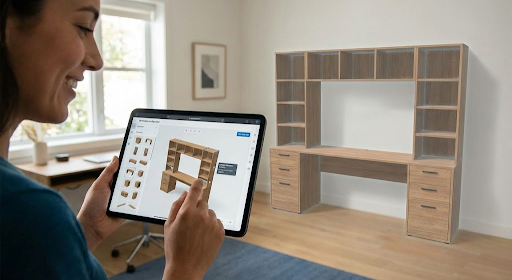
Without real-time visualization, the “paradox of choice” sets in. Customers get overwhelmed by options and abandon their carts. The solution is to move from “choosing” to “building” through an advanced 3D Product Configurator.
Solving the “Will it Fit?” Crisis with AR
The biggest friction point in furniture e-commerce is spatial uncertainty. Even with a 3D model, customers worry about the physical footprint in their room.
This is where the 3D & AR Viewer changes the game. By allowing users to project their custom modular desk into their actual office space via Augmented Reality, you eliminate the “measurement doubt.” This doesn’t just increase sales; it drastically slashes return rates—a critical metric for heavy-goods shipping.
Seamless Workflow: From Pixels to Production
A modular configurator is only as good as its backend. Each custom configuration must be translated into a precise list of parts for fulfillment.
Whether your brand is built on Shopify, BigCommerce, or WooCommerce, Zakeke’s integration ensures that when a customer hits “Order,” your warehouse receives a clean Bill of Materials (BOM). This automation is what allows small modular brands to compete with global giants.
Why Customization is a Sustainability Win
Today’s consumer values longevity. Modular furniture is inherently sustainable because it is repairable and expandable. By offering a modular desk configurator, you are selling a product that grows with the user.
Using Visual Product Customization to allow for custom finishes (like eco-friendly laminates or recycled textures) adds a layer of personalization that resonates with the modern, eco-conscious professional.
Strategic Takeaways for 2026:
- Embrace Modularity: Shift your catalog from “Fixed SKUs” to “Configurable Components.”
- Visualize the Invisible: Use 3D to show internal cable management, drawer depths, and hidden features.
- Integrate for Scale: Ensure your e-commerce integration handles the complex logic of modular pricing and parts.